
The optical lens supplier 3L-Systems strives to provide optical components tailored to customer demands, offering world-class coating designs and services.
- Optical Coating
-
Optical coatings are designed to manipulate the reflectance, penetration, or polarization properties of optical components.
Coatings are composed of one or more layers of dielectrics, IR Materials, or metal materials.
Each coating is designed for a specific wavelength range or band.- Wavelength from 213nm to 14㎛
- Fast custom designs
- AR coating lens
- ITO coatings and in-house environmental testing
SINGLE LAYER ANTI-REFLECTION (AR) COATING
SPEC
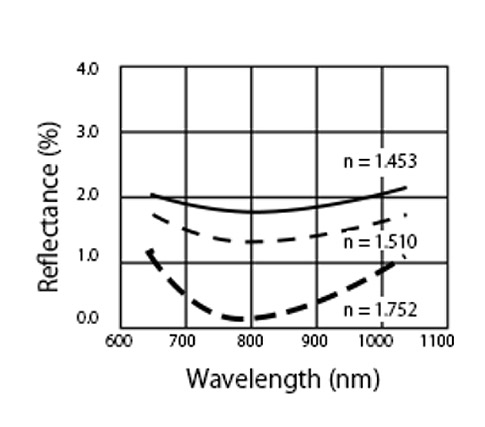
MgF2, with its ideal refractive index (1.35@550 nm) and high durability, is commonly used for AR coating on lenses, windows, and beam splitters.
A single-layer AR coating lens is usable across nearly all incident angles and all wavelength bands from UV to IR.
A layer of MgF2 coated on fused silica substrates reduces surface reflectance across a wide range to less than 1.5% per surface.
LASER LINE V-COATING
SPEC
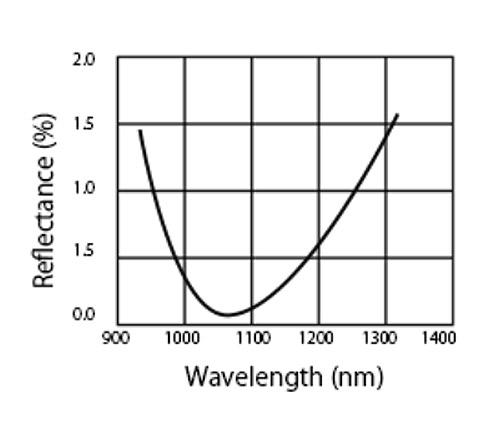
V-Coating is a multi-layer AR coating that reduces surface reflectance to less than 0.25% at a chosen single wavelength with an incident angle of 0 degrees.
Applying V-Coating to fused silica brings excellent penetration.
3L-Systems offers V-Coating across all wavelength bands from 193 nm to 2,940 nm.
DOUBLE-V AR COATING
SPEC
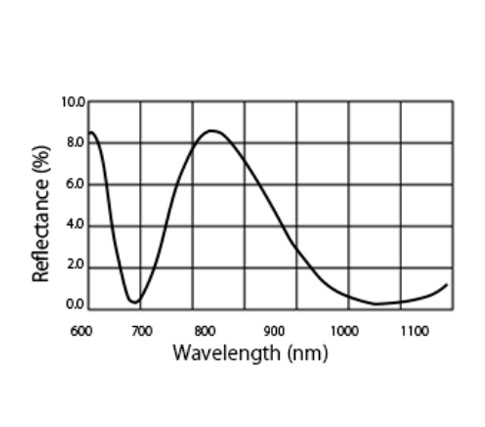
Double-V AR coating offers V-Coating performance at two selected wavelengths.
This coating has versatile uses in optical devices transmitting visible alignment lasers as well as NIR beams (e.g., Nd:YAG Laser).
Double-V AR coating for NIR has an average reflectance of less than 0.25%, and for common AOIs in the visible range, it offers an average reflectance of less than 0.5%.
BROADBAND MULTILAYER AR COATING
SPEC
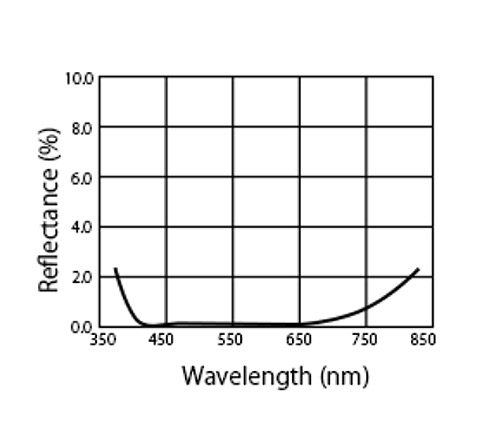
BBAR coating provides minimum reflectance across a wide spectrum.
Average reflection loss is reduced to less than 0.5% per surface in the selected wavelength range.
BBAR coating, with its multiple layers, has a higher level of coating complexity compared to single-layer AR coatings and is sensitive to incident angle.
LASER LINE HIGH REFLECTOR
SPEC
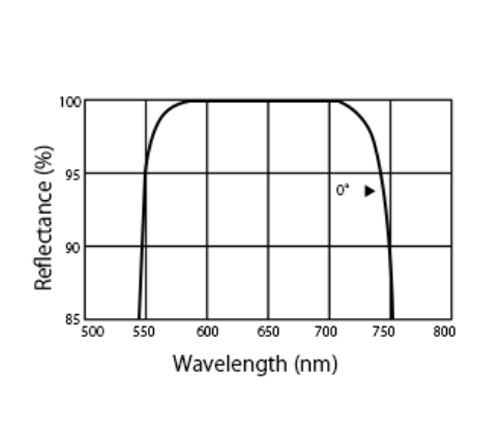
The laser line high reflector coating offers more than 99% reflectance at a specific laser wavelength.
It’s also used to construct wideband reflection mirrors for multi-spectrum applications,
Proving more efficient than metal coatings, and can be used with lasers or broad-spectrum sources.
PARTIAL REFLECTOR
SPEC
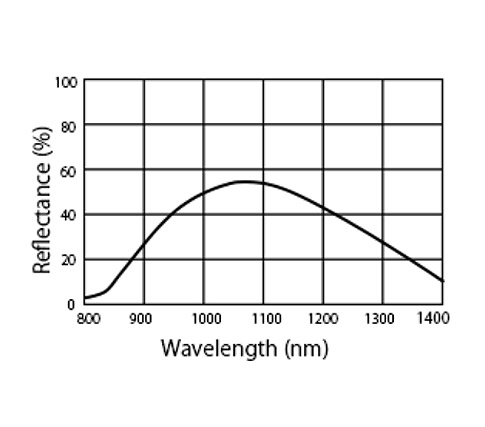
Partial reflector coating is used as a laser output coupler at an incident angle of 0 degree.
You should choose the appropriate output coupler to maximize output/energy ratio.
3L-Systems offers high-quality laser-cavity coatings to minimize light scattering.
EDGE PASS COATING
SPEC
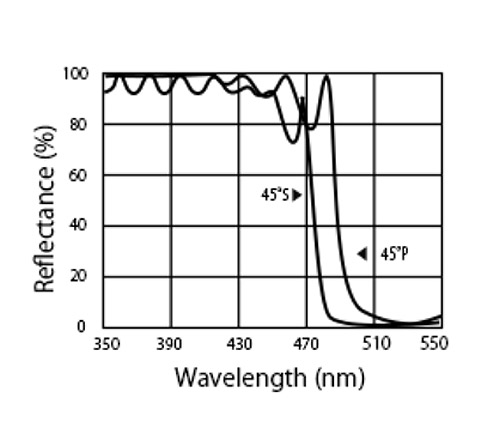
Edge pass coating has a significant gap between penetration and reflectance zones.
Long wave pass coatings reflect shorter wavelengths and transmit longer ones.
Meanwhile, short wave pass coatings reflect long wavelengths and transmit shorter ones.
The cut-on/off wavelength is where the penetration is at 50% of its peak value.
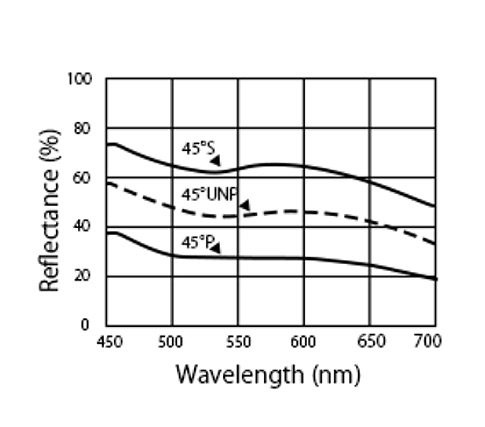
POLARIZING BEAM SPLITTER COATING
SPEC
Beam splitters are used to separate or combine two different beams.
Plates are used in most laser applications due to their minimal absorption.
Cubes are mainly used in low-power applications.
Polarizing beam splitter coatings provide an efficient method of directing randomly polarized incident laser beams into “S” or “P” states for specific wavelengths or ranges.
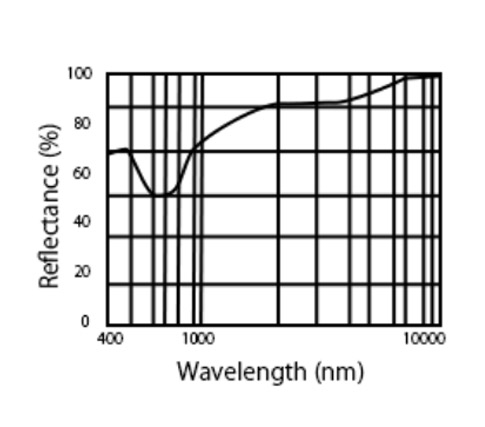
METALLIC COATING
SPEC
Metallic coatings have a lower reflectance than dielectric coatings, ensuring effective mechanical durability and damage thresholds.
Advantages of metallic coatings include low costs, ultra-wideband performance, and insensitivity to incident angles and polarization.